

why maps lie: the intersection of cartography & power
brief dive 04: the history of maps, the problem of distortion, and how cartography has long been intertwined with power and politics

Welcome to the brief dives series — a project to turn research into something both informative and accessible. The hope is to inspire continued learning and encourage curiosity, both for myself and for anyone who enjoys exploring the stories behind the things we encounter every day.
A map, in and of itself, seems inherently trustworthy.
We use them, rely on them, learn from them from the early years of childhood all the way through adulthood. They’re one of the few things we’re taught to read as fact without much second thought. Everything is labeled, bordered, placed exactly where it’s supposed to be — so why would we question it? It exists outside of interpretation, the world laid out clearly in front of you.
But maps aren’t entirely neutral — and they never really have been. Once you notice it, it’s hard to unsee it.
Maps aren’t solely for showing the world, they’re also shaping how we see it.
Map Origins
Maps weren’t always accurate in the way we think of accuracy now. Instead, they were used to make sense of the world. Long before precise measurements or satellite imaging, maps reflected what people believed to be true geographically, but also culturally and spiritually.
The earliest maps carved into clay tablets or drawn onto papyrus, they mapped out rivers, trade routes, and nearby land, like the Babylonian Map of the World (Imago Mundi, or “Image of the World”), which is the oldest known world map.
Similarly, in Ancient Greece, figures like Anaximander and later, Ptolemy, began trying to map the world more systematically with the introduction of the early ideas of coordinates and scale. But even then, large portions of the world were still unknown, and often filled in with assumption. From the very beginning, maps were a mix of what was known and what was believed.
Into the Medieval Period, European maps, often referred to as Mappa Mundi or “cloth of the world”, weren’t designed for navigation so much as they were for culture and understanding.
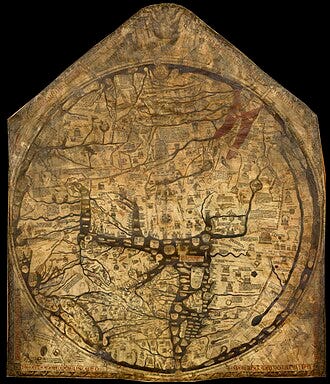
In many of these maps, Jerusalem sat firmly at the center of the world because it was understood to be the spiritual center of human existence. East was often placed at the top of the map, which feels disorienting now, but it aligns with the direction of the rising sun and the believed location of the Garden of Eden. Orientation itself wasn’t yet standardized, and instead, the maps were layered meaning, hierarchy, and belief. It was a world created, structured, and understood through a religious and cultural lens.
And the parts of the world people didn’t understand — the unknown — weren’t left empty but instead filled by sea monsters, mythological creatures, and entire regions shaped more by imagination than observation. You’ll often see phrases like “hic sunt dracones”, or “here be dragons”, marking the edges of the known world to denote danger or unknown regions.
In a way, these maps were more honest about their limitations than later ones would be, with a delineation of known and unknown. And in doing so, they unintentionally reveal something important: maps have always been shaped by the people creating them. Shaped by their beliefs and priorities, and their understanding of the world and their place within it.
Exploration & the New Era of Maps
As exploration expanded, so did the need for something more precise. Maps could no longer just explain the world, they were now needed to navigate the unknown into something known.
The Age of Exploration marked a turning point, not just in how much of the world was known, but in how it was mapped. Coastlines became more defined, distances more carefully measured, and for the first time, there was a growing sense that the world could be charted in a consistent and reliable way. And maps began more familiar to what we now use.
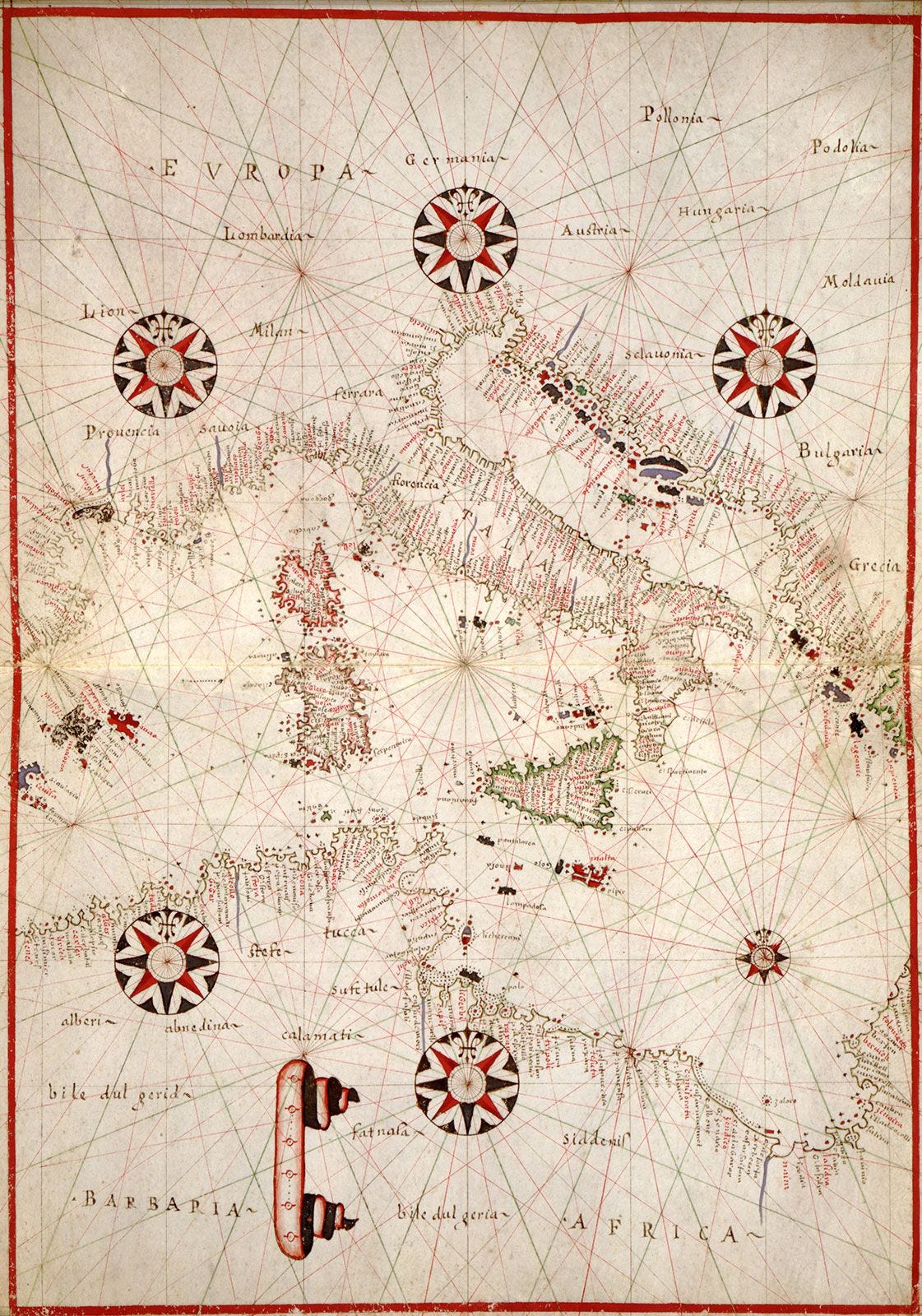
Portolan Charts (from the word “portolani”, or “pilots”) are among the first of these highly detailed navigational maps. These nautical charts that focused on coastlines, harbors, and compass directions, aided sailors in navigating the Mediterranean. Portolans had no fixed reference point, and instead use a compass rose and Rhumb lines were used by sailors to plot bearings and calculate progress of voyages.
By the 15th and 16th centuries, European exploration had moved far beyond familiar coastlines. Spanish and Portuguese expeditions were moving across oceans, and sailors were no longer traveling along the edges of land, but through open water, often without any visible reference points, as they established trade routes that connected Europe to Africa, Asia, and the Americas. This is where cartography begins to shift in a more tangible way, and new types of maps began to emerge.
Though the concept of latitude and longitude had existed earlier, most notably through the work of Ptolemy, it was during this period that it began to be applied more widely in practice. The Earth could now be divided into coordinates, allowing locations on the New World to be plotted rather than just described.
Maps began to be grounded in observation, mathematics, and repeatable systems — systems that could get ships across oceans and bring them back.
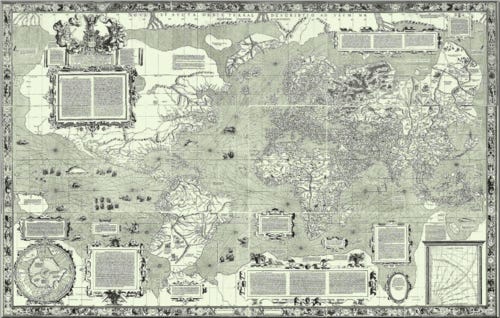
By the mid-16th century, this confidence began to take on a more formal shape. Cartographers were trying to standardize the way the globe was plotted on paper. In 1569, Gerardus Mercator introduced a new kind of world map projection, one that would become one of the most widely used in history. It allowed sailors to plot straight-line courses across the ocean — a major breakthrough for navigation. For the first time, the world could be represented in a way that was measurable and usable.
But in order to make the world fit onto a flat surface, something had to give.
The Problem: You Cannot Flatten the Earth
The Earth is a sphere, borders and tectonic plates alike constantly shifting and evolving through history, but a sphere nonetheless, — and a map is two-dimensional. Due to geometrical limitations, this means you cannot take a spherical object and flatten it without distortion. Every map you’ve ever looked at is the result of this problem being solved, or more accurately, compromised upon. Chances are, almost every map you’ve ever looked at is the result of this constraint being negotiated.
The Mercator projection was designed so that straight lines on a map corresponded to constant compass directions. For sailors crossing open oceans, this was incredibly useful. A straight line drawn across the map could be followed as a consistent bearing, making long-distance navigation far more manageable — and it that sense, it worked precisely as intended.
Bus as you move away from the equator, landmasses begin to stretch dramatically. Regions closer to the poles expand outward, while those near the equator remain comparatively compressed. Greenland, for example, appears comparable in size to Africa though Africa is roughly fourteen times larger.
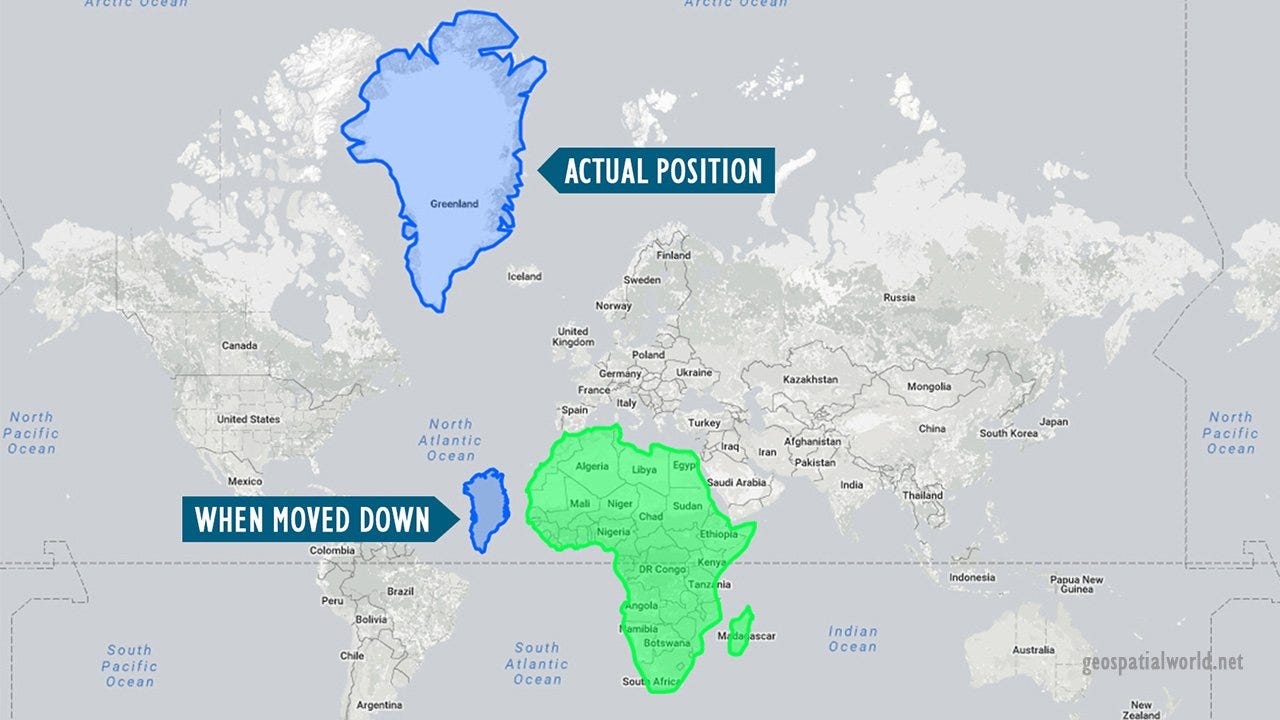
And because this projection became one of the most widely used in education, navigation, and global representation, those distortions don’t just exist on paper but also in our perception of the world. Because when a map consistently enlarges certain regions and minimizes others, it subtly reshapes influences what feels central and powerful.
The Mercator projection wasn’t created to mislead, but it emerged at a time when European nations were expanding outward — mapping and claiming large parts of the world. And the version of the world it presented, one where Europe sat prominently and expansively, aligned, intentionally or not, with that movement of power, reinforcing it visually.
And this is where maps begin to lie — as something that presents a version of reality so clearly and consistently, that it becomes difficult to see it as anything other than reality.
Distortion is Power
Scale is a powerful thing, even when we don’t consciously register it.
When a something appears larger, it doesn’t just take up more space visually, it also begins to feel more significant, while something that is consistently shown as smaller, can seem more secondary. And what makes this particularly interesting is that none of this requires intention.
The Mercator projection wasn’t designed to elevate certain regions or diminish others. The distortions it creates are a byproduct of preserving direction, so a technical decision, not a political one. Though the outcome is not entirely neutral as this technical decision aligns with existing structures of power, enlarging the same regions that already hold economic, political, or cultural influence. And unintentionally, it begins to reinforce them.
By the time modern maps became widely distributed through education and media, this version of the world dictated by the Mercator projection had already taken hold. Europe and North America appearing expansive and central, while much of the Global South appeared reduced in scale and visually diminished. This is what makes distortion more than just a technical limitation, though often unintentionally, when it comes to power and politics.
The distortion on the map carries outward into how we think about place and its importance, and what is central and what is not.
Maps, Power, & Politics
If distortion shapes perception, then the next question is: what happens when that perception aligns with power?
One of the simplest ways to explain this is in what a map chooses to center. Most of us grew up with world maps that are centered around Europe or the Atlantic Ocean. It’s such a familiar layout but there is no natural center of the Earth. A map could just as easily be centered on the Pacific, or split in entirely different ways.
What makes maps powerful is not just that they simplify the world. It’s that they do so visually, authoritatively, and often permanently. A map takes argument and turns it into image. Cognitive research on repetition and visual memory helps explain why: repeated information tends to feel truer, and pictures are often remembered better than words. In other words, maps have a built-in persuasive advantage. Even the United Nations routinely places disclaimers on maps noting that boundaries and names shown do not imply official endorsement, precisely because maps carry legal and political weight far beyond simple illustration
Maps do not merely record political reality, they also help manufacture it.
This shows up explicitly during the period when maps became tools of expansion. During European colonialism, mapping was just about defining the world as it was documenting the world. To map a place was to make it legible in a way that could be navigated, governed, and claimed. Entire regions were reorganized through systems that made sense to those drawing the maps, not necessarily those living within them. And this continues throughout history.
During the era of “The Scramble for Africa”, The Berlin Conference of 1884 - 1885 brought major European states together to establish rules for colonial occupation in Africa, despite the fact that no African representatives were present in those negotiations. The conference did not finalize every border on the continent, but it helped formalize the principle that European powers could claim territory through “effective occupation,” accelerating the colonial partition that followed. The result was not a map emerging from the land itself, but a land increasingly forced to conform to the map. The African Union notes that inherited colonial borders have remained a recurring source of disputes and conflict. International legal sources likewise describe many African boundary disputes as rooted in artificially and arbitrarily drawn colonial frontiers. This is one of the clearest examples of cartographic power: a line can be historically contingent, politically imposed, and still become materially binding for generations.1
The Middle East offers another version of the same story. The 1916 Sykes-Picot Agreement, negotiated by Britain and France with Russian assent, proposed dividing Ottoman Arab territories into spheres of influence and control. Whatever the later adjustments and complications, the significance of the agreement is not just in the exact borders it produced, but in the mindset it revealed: that regions could be parceled, and divided from afar. And a map became a planning surface for empire.2
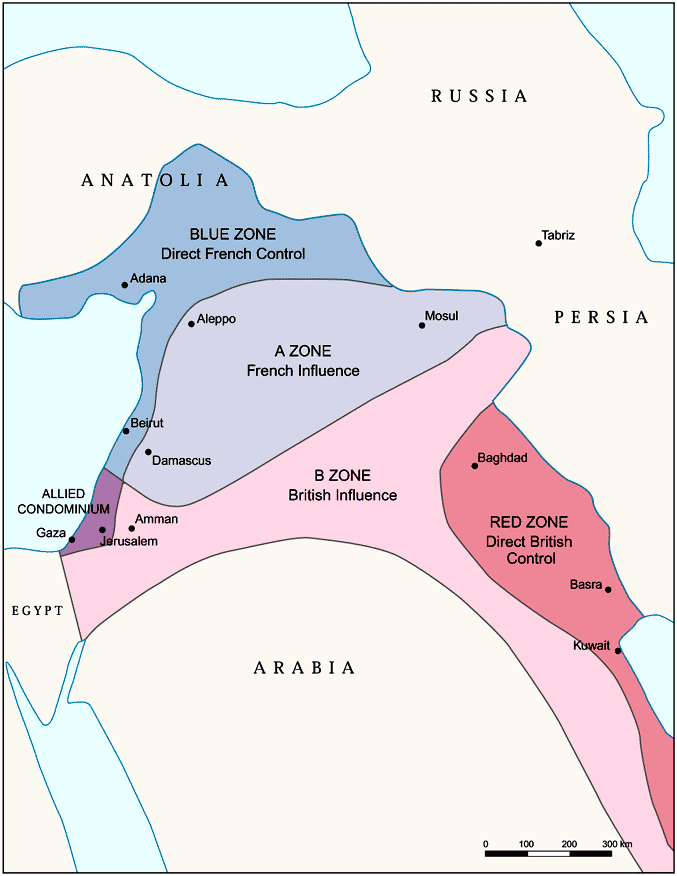
Beyond distortions, this is what makes the politics of maps so controversial. Ethnic overlap, tribal movement, trade networks, pilgrimage routes, linguistic regions, ecological systems, seasonal migration, mixed sovereignty, disputed claims — all of that complexity gets flattened into a border that looks simple and clean. Politics is rarely that clean— and the more complicated the reality, the more forceful the visual simplification becomes.
Because the borders drawn during colonial rule did not disappear when those empires did, they became the foundation for modern states, international law, and global recognition. The lines that were once negotiated were carried forward into independence (as seen in Africa), often preserved in an effort to maintain stability, even when they did not reflect the realities on the ground. Which means many of the tensions embedded in those maps are never actually resolved.
You can still see this in ongoing border disputes across the world in the places where lines that appear definitive on a map are, in practice, anything but. Where borders are contested, reinterpreted, or actively fought over, what is shown as fixed is, in reality, still unsettled. And yet, the map presents it cleanly.
You can even see this in the present. Maps are still taking something contested, and translating it into something that appears stable. Digital mapmakers still make political choices. Only now, instead of presenting one fixed version, they present multiple versions, each shaped by a different set of priorities. Google has publicly acknowledged that when neighboring countries claim overlapping territories or place names, what users see can vary by location and local law; for example, disputed borders may appear differently depending on the country from which a user is viewing the map. And that is, in many ways, a continuation of the same pattern. We often treat technology as truth, but with this being said, it can be argued that there is no singular, universally neutral border even in the maps many people now treat as default reality.
And that is where the lie lives — not in what the map shows, but in how confidently it shows it.
Maps don’t lie in the way we usually think about lying with malicious intent and inherent deception. They are, at their core, attempts to make something impossibly complex understandable. But it doing so, decisions and distortions have to be made.
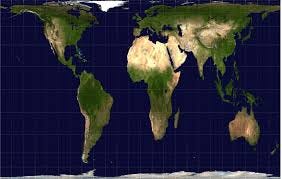
In the 20th century, maps like the Gall-Peters Projection were introduced to preserve area more accurately, presenting continents like Africa and South America in proportions closer to their actual size. But in doing so, shapes become stretched, unfamiliar — even uncomfortable to look at. And that reaction is telling because it shows how deeply we’ve internalized one version of the world as normal.
There is no perfect map. Only different ways of prioritizing what matters and translating a three-dimensional, constantly evolving world into something flat and still. It’s important to recognize that what you’re looking at is not the world itself, but a version of it that has been shaped, translated, and influenced long before it reached you.
Maps lie because they don’t just show us the world— they shape the way we believe it exists.
follow me on rhome for more recommendations
join the snail mail club
This was such a fascinating read. It speaks to the fact that those that shape our knowledge and perception of things really do hold the keys to the kingdom. Cartographers are no different than historians who had the ability to prioritise that whcih THEY thought needed preserving. There are so many examples of historical facts that were edited out because they didn't fit the narrative of the time. This is no different than with maps. America and Europe were the big guns and they portrayed themselves as such on a map and it just turned in to a self-fulfilling prophecy! Thank you for sharing. It was a compelling article and full of amazing facts.
This is such a fresh read for someone like me who doesn’t get a chance to research much. You totally challenged my beliefs, great work